
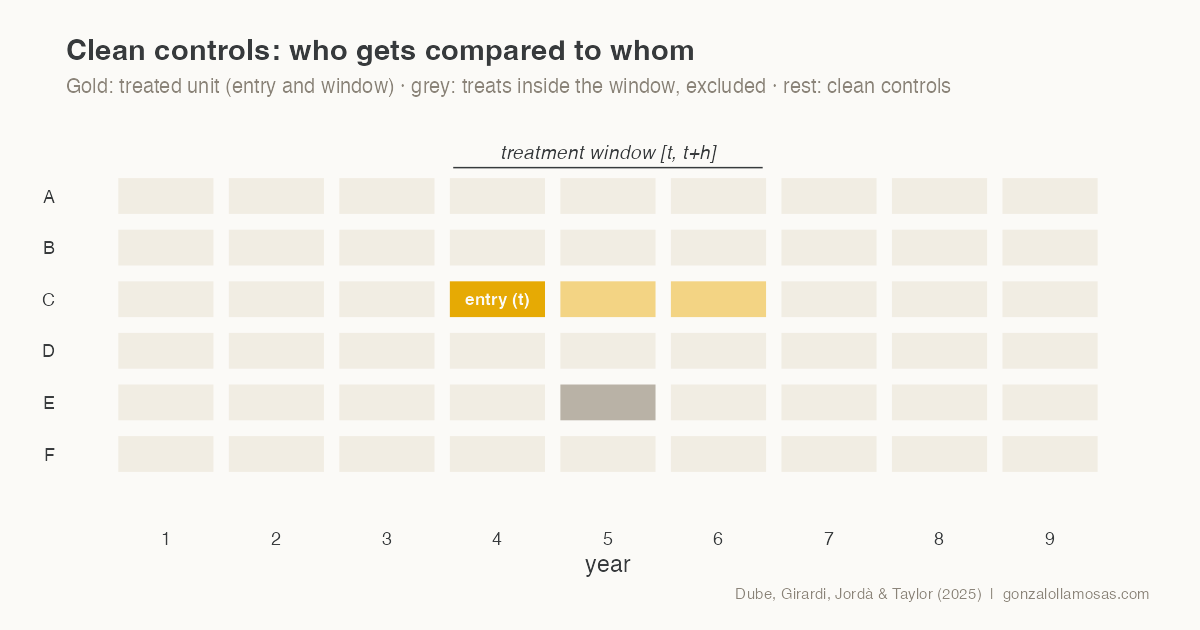
Event studies on macro panels have a known problem. In a standard two-way fixed effects setup, countries that treated earlier serve as controls for countries that treat later, and vice versa. When treatment effects are heterogeneous or dynamic, those comparisons contaminate the estimates, a point the difference-in-differences literature has made forcefully over the last few years. Fiscal policy applications are especially exposed, because consolidation episodes cluster in time, think 2010 to 2013, and their effects build slowly.
The Local Projections Difference-in-Differences estimator of Dube, Girardi, Jordà and Taylor (2025, Journal of Applied Econometrics) addresses this with two design choices that are easy to state and easy to audit. In a paper with Cristina Mazas Pérez-Oleaga and José M. Domínguez-Martínez, now under review, we apply it to 125 fiscal consolidation entries in the EU-27. A few practical lessons follow.
The two design choices
First, treatment is defined as entry. The treatment indicator switches on in the year a country crosses the consolidation threshold, an improvement of at least one percentage point of potential GDP in the cyclically adjusted primary balance, and what is estimated is the effect of entering an episode, horizon by horizon.
Second, and this is the core of the method, the control group at each horizon contains only clean observations, meaning countries that are not treated anywhere in the window from the entry year to the horizon of interest. No forbidden comparisons enter the estimate. The outcome is a long difference from the pre-treatment year, and the specification adds country fixed effects, year-by-horizon fixed effects, two lags of the outcome change and lagged macro controls.
The cost is transparency about sample loss. Of the 128 entries in our panel, 125 enter the estimation sample at the impact horizon and 97 remain at five years, and the control pool shrinks as the horizon lengthens. We report the counts at every horizon, and we would encourage anyone using the method to do the same, because the estimand quietly changes with the surviving sample.
The estimator in a few lines of R
Stripped to its essentials, the whole procedure fits on one screen. For each horizon, build the long difference, flag the units that stay untreated through the window, keep entries and clean controls only, and run the fixed-effects regression.
library(dplyr)
library(fixest)

lpdid_h <- function(panel, h) {
  df <- panel |>
    group_by(country) |>
    mutate(
      d_y   = lead(debt_gdp, h) - lag(debt_gdp, 1),           # long difference
      clean = slider::slide_dbl(entry, max, .after = h) == 0  # untreated in [t, t+h]
    ) |>
    ungroup() |>
    filter(entry == 1 | clean)                                # no forbidden comparisons

  # specification (ii) adds pb_l1, the primary balance in t-1
  feols(d_y ~ entry + d_debt_l1 + d_debt_l2 + x_l1 | country + year,
        data = df, cluster = ~country)
}

irf <- lapply(0:5, function(h) lpdid_h(panel, h))

# 27 clusters: complement with a wild cluster bootstrap (Webb weights)
fwildclusterboot::boottest(irf[[1]], param = "entry",
                           B = 9999, type = "webb")
Each element of irf is one point of the impulse response, and the header figure of this post was drawn with the same logic. The real code adds the placebo horizons, the trimming and the robustness battery, but nothing conceptually new.
What we learned applying it
Inference with 27 clusters deserves more care than the default. We cluster at the country level and complement the usual standard errors with a wild cluster bootstrap using six-point Webb weights, which behaves better with few clusters. With our baseline controls, the short-run increase in the debt ratio survives both. The more useful lesson came from somewhere else.
Check covariate balance before reading any coefficient. Our entrants started with a primary balance 2.6 points of GDP worse than their controls, and countries with worse balances accumulate more debt whether or not they consolidate. Adding the lagged primary balance to the controls removes the short-run increase and leaves the response imprecisely estimated around zero. We now report every estimate with and without it.
Pre-trends are worth showing and worth reading with care. Placebo coefficients one to three years before entry are insignificant in both specifications, but under the baseline all three are positive, and a sensitivity analysis in the spirit of Rambachan and Roth (2023) shows that the baseline impact estimate is fragile to modest violations of parallel trends. An insignificant placebo is not the same as a flat pre-trend.
Power, not bias, is the binding constraint at long horizons. Our point estimates grow with the horizon while their precision falls, and the honest reading is that the short-run estimates are the informative ones.
The paper, which also decomposes the debt response exactly into the primary balance, the snowball effect and stock-flow adjustments, is under review; the Research page has a summary.
Gonzalo Llamosas García, Málaga